
05 / CHEATSHEETS / 02

Elliott wave atlas

Impulses, corrections and diagonals. Switch sections without leaving the page.

Impulse rules

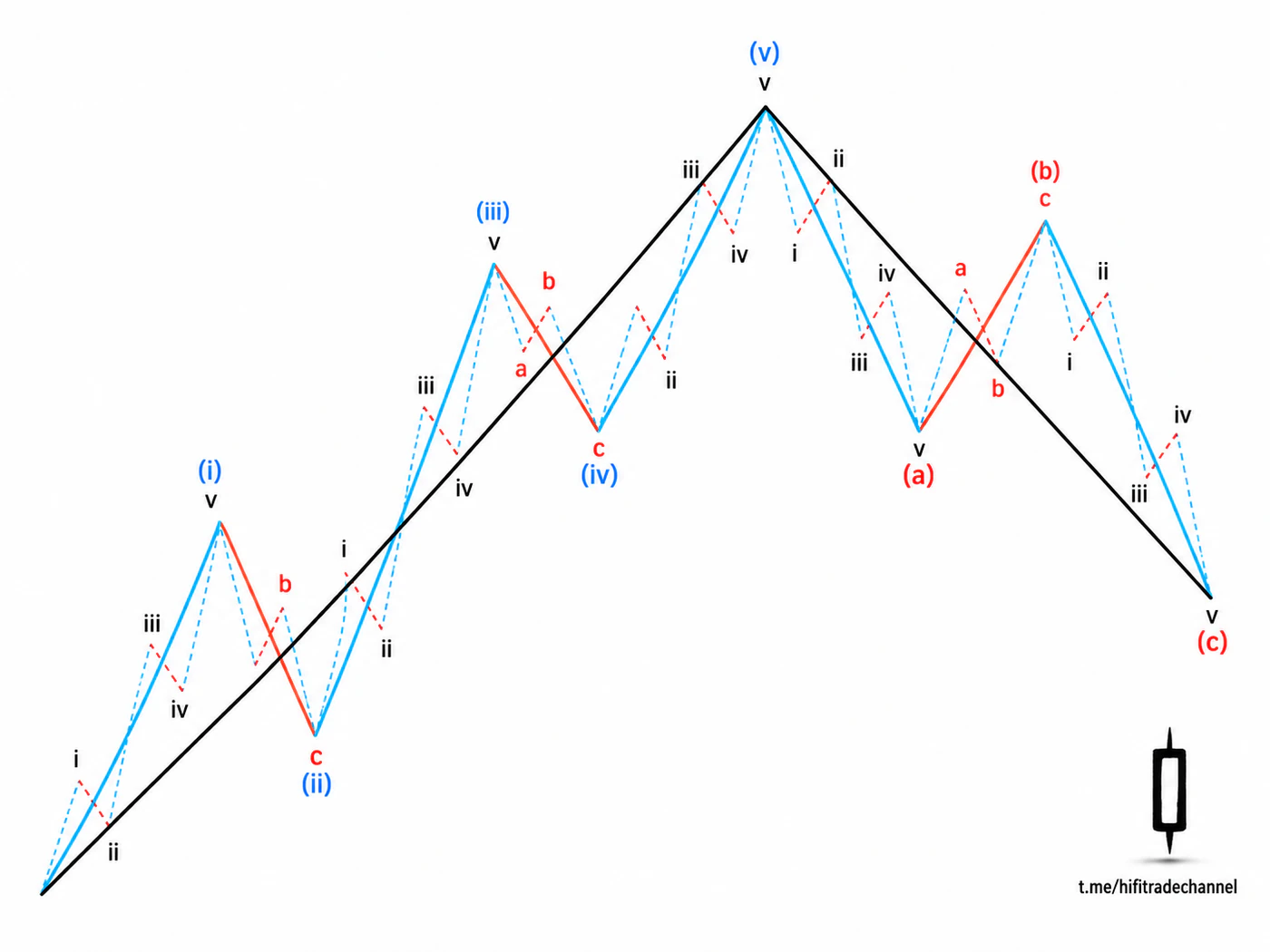
5–3–5–3–5
5–3–5–3–5

Impulse rules

Five waves with the trend. Wave 2 does not exceed the start of 1, wave 3 is never the shortest and wave 4 usually avoids wave 1 territory.

01 / 06
RULES

General rules

  • Motive waves always divide into five subwaves: 1, 2, 3, 4 and 5, followed by corrective waves, usually A, B and C.
  • Waves marked 1, 2, 3, 4 and 5 move in the direction of the trend.
  • Waves marked A, B and C move against the trend.
  • The motive structure 5-3-5-3-5 (21 waves) is followed by the corrective structure 5-3-5 (13 waves).
  • Wave 1 and wave A may be a five-wave impulse or a Leading Diagonal.
  • Wave 3 is always a five-wave impulse.
  • Waves 5 and C may be either impulses or Ending Diagonals.
  • Waves 2, 4 and B always divide into three-wave corrections.
  • Wave A may be either a three-wave correction or a Leading Diagonal.

Impulse rules

  • Wave 3 is most often the longest wave and is never the shortest.
  • Wave 2 NEVER moves beyond the origin of wave 1.
  • Wave 3 must move beyond the end of wave 1.
  • Wave 4 should not enter the territory of wave 1. This is the overlap rule, although rare exceptions can occur.
  • Wave 5 most often exceeds the extreme of wave 3 unless the pattern is truncated.
  • All bullish-trend rules are identical to bearish-trend rules when the structure is inverted.
  • All rules apply to any price range.

Recommendations

  • Waves 2 and 4 almost always alternate. For example, if wave 2 is deep (a zigzag), wave 4 will be sideways (a flat or triangle), and vice versa.
  • Wave 4 may be a flat, triangle or combination.
  • Wave 2 is most often a zigzag or a combination of zigzags.
  • Wave 4 usually ends in the same zone where wave 4 inside wave 3 ended.
  • Wave 2 generally retraces 50%, 61.8% or, more rarely, 78.6% of wave 1.
  • Wave 4 generally retraces 38.2% or 50% of wave 3.